|
|
Mid-Ocean Ridges
Types of Ridges |
Axial | Fast/Slow
Spreading | Magnetics & Polarity | Experiment
Fast
Spreading Ridge
Click on the different features of
a fast spreading mid-ocean ridge crest »
Slow-Spreading
Mid-Ocean Ridge
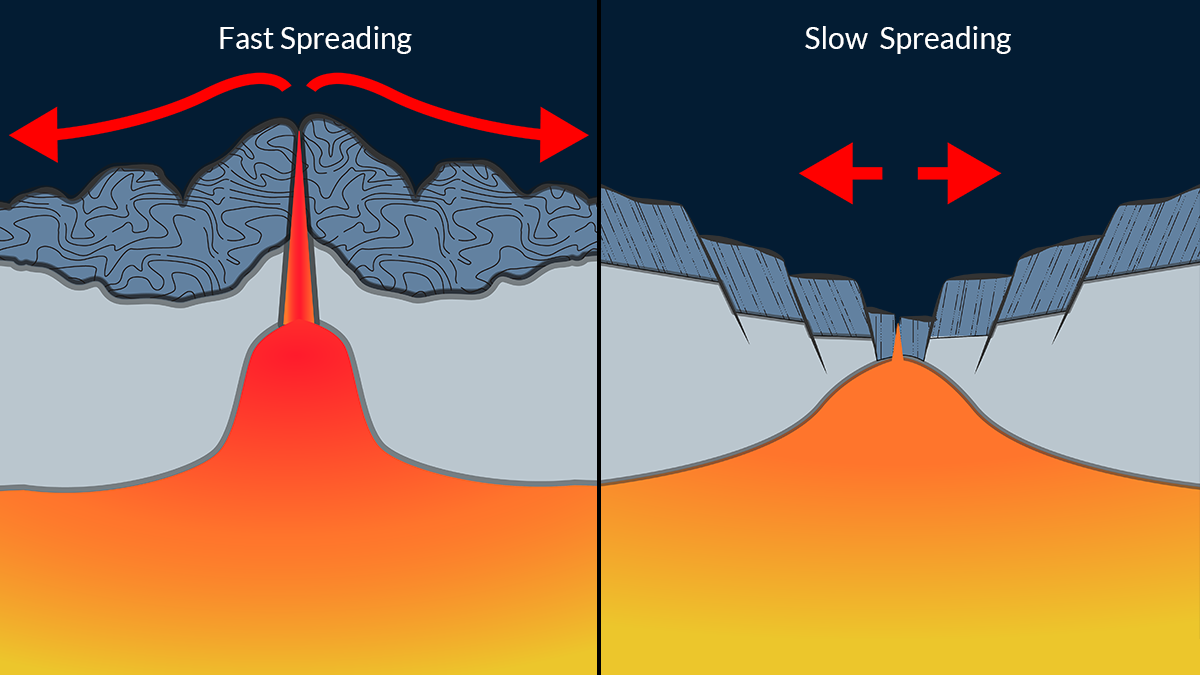
Slow spreading ridges like the Mid-Atlantic Ridge generally have
large, wide rift valleys, sometimes as big as 10-20 km wide and
very rugged terrain at the ridge crest that can have relief of
up to a thousand meters (3,128 feet).
|
Fast-spreading ridges like the northern and southern East Pacific Rise have
smoother topography at the ridge crest and look more like domes. They have
relief of only a few hundred meters down the sides of the ridge to the crest.
They have valleys at the crest of the ridge but usually they are much smaller.
Sometimes these small valleys, or troughs, are less than 100 m wide and only
10-20 meters deep. The axial summit trough of the East Pacific Rise in the
9-10°N region is not very deep (only about 8 to 15 meters deep), and is
also only 50 to 300 meters wide.
Fault
Scarps
Steep steps in the seafloor that can be as tall as a few tens of meters (at
fast spreading ridges) to hundreds of meters (at slow spreading ridges). These
features are also called abyssal hills and are present on both sides of the
ridge axis and are caused cracking of the ocean plate by seafloor spreading.
Back to introduction of fast spreading ridges »
Axial Trough
A narrow (50-300 meter wide) cleft at the axis of a fast-spreading mid-ocean ridge like the East Pacific Rise at 9-10°N Latitude. The axial trough is only 5 to 20 meters deep and is where most of the eruption of lavas takes place. It is also where much of the hydrothermal venting is occuring.
Back to introduction of fast spreading ridges »
Feeder dikes
Long, narrow fissures which are filled with molten rock. These fissures serve as the conduits for magma when it erupts from the magma chamber to the seafloor.
Back to introduction of fast spreading ridges »
Lavas
Volcanic rock that has cooled after magma has erupted on the seafloor. Volcanic rock on the seafloor is mostly basalt. A typical shape for lava to have at the mid-ocean ridge is like big, bulbous pillows. That is why many of the lavas are called pillow basalts.
Back to introduction of fast spreading ridges »
Sheeted dikes
Sheeted dikes are the parallel feeders that transported the magma when it was erupted from the magma chamber to the seafloor. The magma cools and forms a dense rock called a diabase. This type of rock is found in the lower part of the ocean crust.
Back to introduction of fast spreading ridges »
Magma Chamber
A magma chamber is a region of molten or partially molten rock that has oozed out of the hot mantle beneath the mid-ocean ridge crest.
Back to introduction of fast spreading ridges »