



Glaciers Advance and Retreat
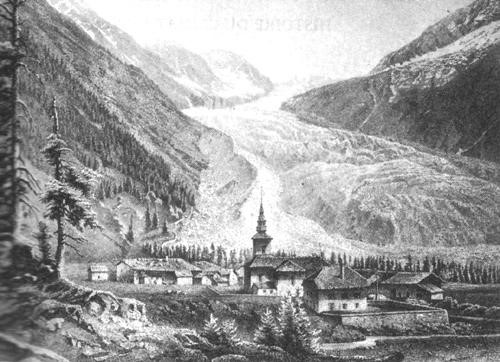
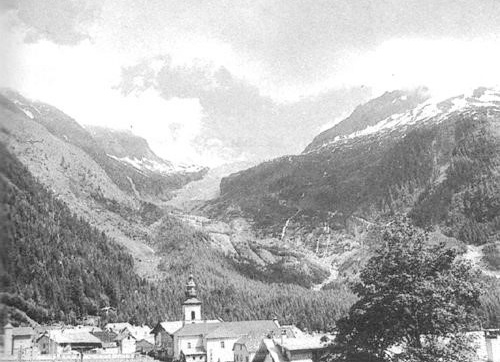
Here is a recent example of showing that glaciers can advance and retreat. The etching done in 1850 is of the Argentine glacier above the town of Argentine, France, and shows the glacier extending down to the edge of the town. In the photograph taken in 1966 of the same area, the valley above the town is ice-free. This is a modern-day example, but how often do ice ages occur?
Ice Ages Timeline
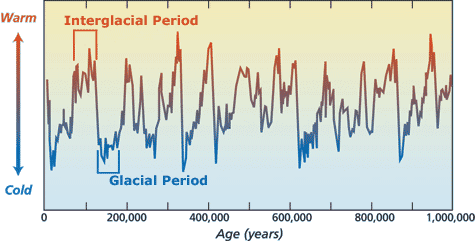
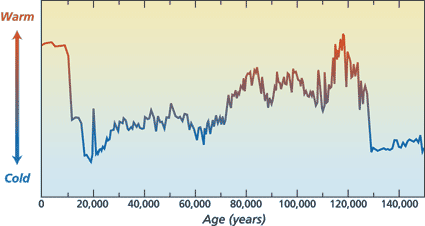
Using chemical information collected from ice cores and from shells of organisms preserved in deep-sea sediments, geologists have been able to map out how Earth's climate has changed over time. Climate swings between cold periods, called glacials, and warm periods, called interglacials. We are currently in an interglacial period.
Past 1,000,000 years
Past 150,000 years
Causes
There are several natural forces that together lead to an ice age on Earth.
The answer lies in how the orbit of the Earth around the sun changes. The average temperature on Earth depends on the Earth’s distance from the sun. If the Earth were closer to the sun, it would be hotter; if the Earth were further away from the sun, it would be colder
A Yugoslav astronomer, Milutin Milankovitch, learned how changes in Earth’s orbit can changes in climate to cause ice ages. He studied three types of changes in Earth’s orbit: its shape, the tilt of the its axis, and the wobble of the its axis.
Shape of the Earth’s Orbit
If the Earth were the only planet orbiting the sun, its path would be circular. But there are other planets circling the sun too. Their gravity pulls slightly on the Earth as they pass nearby, causing the Earth’s orbit to change by a very small amount. The Earth’s orbit changes from circular to slightly elongate and back again about every 100,000 years.
When the orbit is circular, the distance between the sun and the Earth stays the same. But when the orbit is slightly elongate, the sun and Earth vary from being farther away from each other (making the climate colder) to being closer together (making the climate warmer).
Earth’s Tilt
The Earth is slightly tilted—that is what gives us our seasons.
Here’s how it works. On one side of its orbit around the sun, the Earth is tilted towards the sun. During this time, the northern hemisphere receives more heat so has higher temperatures—it is summer.
Six months later, the Earth is on the other side of its orbit, and the Earth is tilted away from the sun. Now, the northern hemisphere receives less heat so it is colder—it is winter.
However, the Earth’s tilt changes from 22° to 24° and back again about every 40,000 years. Right now, it is tilted at 23.5°. When the tilt is at its greatest, differences in temperatures between summer and winter will be greatest.
Earth’s Wobble
Like a spinning top as it is slowing down, the Earth’s axis wobbles in a circle every 23,000 years.
Because of this wobble, the Earth moves just a little bit more than one complete orbit each year. So, for example, if the Earth is in one place its orbit on, say, 1 July, it will be just a little bit further around the orbit on 1 July of the following year. This is called “precession.”
If Earth’s orbit is slightly elongate, then the distance between the sun and Earth will be different each 1 July, making the summer either cooler or warmer.
Combined Effect
When these three changes in Earth's orbit—its shape, the tilt of the Earth's axis, and the wobble of the Earth's axis—are combined, they can explain why we get glacial and interglacial periods.
Glacial periods occur when the Earth's orbit is elongate, when the Earth's axis has a low tilt, and when northern hemisphere summer occurs at a position on the orbit farther away from the sun so that it is cool.