Octopi

There are several species of octopi that only live
around hydrothermal vents. Some species have only been seen a few times.
They are typically one meter long, and their heads are about the size
of an orange.
Octopi are top predators. They live among or even under clumps of mussels. They
eat crabs, clams, and mussels.
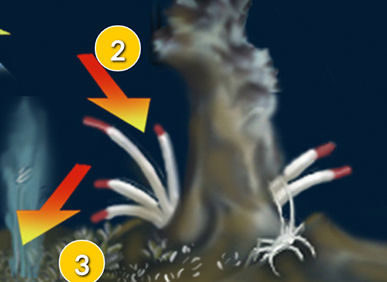
Dandelions

These fuzzy-looking balls are made up of a colony
of numerous individual animals that hold onto each other. The animals
in these colonies are related to the Portuguese-Man-O- War and other
jellyfish. They use long whisker-like tentacles to anchor themselves
on rocks and to move around.
The dandelions are scavengers. They are some of the last animals to colonize
vent sites. If there are a lot of dandelions around a vent site, it usually means
that the vents are no longer active and most of the other organisms in the area
are dying.
Zoarcid
Fish

These two-foot long white fish are top predators
around vents. They eat everything from tubeworms to shrimp. Despite their
huge appetites, these fish are slow and lethargic. They spend a lot of
time floating around clumps of tube worms and mussels.
Microbes

Hydrothermal vent microbes include bacteria and
Archaea, the most ancient forms of life. These microbes form the base
of the food chain. They are chemo-autotrophic, meaning they harvest energy
from a variety of different chemicals gushing out of the vents. They
then use the energy to manufacture sugars from carbon dioxide.
Microbes grow on every surface including rocks, animals, and the inside of chimneys.
Even equipment that
Alvin has left on the bottom is quickly covered. Some
bacteria live inside tubeworms, clams, and mussels, forming symbiotic relationships
with these animals.
Each species prefers a specific water temperature. Different species extract
energy from different chemicals, including hydrogen, hydrogen sulfide, and iron.
Scientists have barely begun to learn about these microbes. They are using genetic
techniques to identify new species and are trying to learn where they live and
which vent chemicals they use.
Clams

Clams colonize hydrothermal vents later than mussels.
Each clam has a big muscular foot that it wedges into cracks in the ocean
floor. A clam also uses its foot to move around.
Just like the mussels, clams depend on symbiotic bacteria that live in the their
gills. These bacteria use the chemicals in the hydrothermal fluid to produce
sugars. The clams use some of these sugars for food.
Despite their thick shells, clams are eaten by crabs and octopi.
Shrimp

There are 15 species of shrimp that live around
vent sites throughout the world. Roughly half live in the Atlantic and
half live in the Pacific. In the Pacific Ocean, each vent site supports
only one species of shrimp. They typically live around clumps of tube
worms and mussels.
In the Atlantic Ocean, shrimp often gather in huge swarms along the sides of
active black smokers. These swarms may contain as many as 30 thousand animals
per square meter. The shrimp eat microbes that grow on the chimney and may even
eat the microbes that grow on their bodies. Some also eat mussels. Crabs, anemones,
and zoarcid fish eat shrimp.
Mussels

Mussels are often the first shellfish to colonize
hydrothermal vent sites. They clump together in cracks in the seafloor.
Symbiotic microbes live in the mussels' gills. Like the microbes living
inside tubeworms, these microbes use energy from chemicals in the vent
fluids to produce sugars. The mussels use sugars produced by the symbiotic
bacteria. Mussels can also filter food from the water, so if hydrothermal
fluid stops flowing, mussels can survive for a short period of time.
When mussels want to move, they shoot out a thread, much like a spider shoots
out a web strand. The end of the thread sticks to hard a surface such as a rock
or another mussel. Then the mussel reels itself in along the thread. Crabs and
shrimp feast on mussels.
Crabs

There are several species of crabs that live around
hydrothermal vents. One type is the Galatheid crab, or squat lobster.
These white crabs live throughout the ocean, but their numbers increase
around hydrothermal vents where food is plentiful. These crabs are scavengers.
They hang out in mussel beds where they eat bacteria and dead animals.
Brachyuran crabs live around vent sites in the Pacific Ocean. These round white
crabs are fierce predators. They eat bacteria, shrimp, mussels, clams, tubeworms,
and even each other.